Why You Self-Sabotage When Things Start Going Well

There's a pattern that almost nobody talks about.
Not the kind of struggle that shows up when life is hard. Not the kind that makes sense. The kind that shows up right when things start going well.
You finally get the momentum. The opportunity arrives. The relationship deepens, the business grows, the life you've been working toward starts to feel within reach.
And then something in you pulls back.
You pick a fight. You procrastinate. You overthink decisions that previously felt clear. You create a problem that didn't exist the week before. And you don't even fully realize you're doing it until you're already several steps back from where you were.
This is self-sabotage. And it is far more common, far more misunderstood, and far more biological than most people realize.
The first thing I want you to understand is this: self-sabotage is not a character flaw. It is not evidence that you're incapable of having a good life. It is not proof that you're broken or self-destructive or secretly afraid of success in some deep psychological way that can never be untangled.
It is your nervous system doing exactly what it was designed to do.
Here's the neuroscience. Your basal ganglia - the part of your brain responsible for automation - stores patterns, habits, and repetitions. It is extraordinarily efficient and completely indifferent to your happiness. Because your brain doesn't optimize for happiness.
It optimizes for predictability.
And to your nervous system, predictability equals safety.
So if you've spent twenty years being the responsible one, the strong one, the one who handles everything for everyone else, your nervous system has encoded that identity as safe. Even if it exhausts you. Even if some quiet part of you has been wanting something different for years. That familiar version of you is what your brain knows. And what it knows, it protects.
So when life starts to expand - more success, more visibility, more ease, more of what you actually want - your brain doesn't immediately celebrate.
It scans for threat.
There's a dopamine component to this that most people find genuinely surprising. When you're in pursuit of something, dopamine rises. It drives motivation, focus, forward movement. It feels good to be working toward something. But here's what happens when you actually get closer to the thing you've been working toward.
Cortisol can spike.
Not because something is wrong. But because success changes your identity, and identity change triggers uncertainty in the brain. Your brain is a prediction machine. It is constantly forecasting what comes next based on who you have already been. So when you start stepping into a version of yourself that your brain doesn't recognize yet, it throws up resistance.
Not because it wants you small.
Because it wants you safe.
I experienced this firsthand when my business started gaining real traction. More visibility, more engagement, more opportunity arriving all at once. And instead of feeling excited, I felt this strange, creeping anxiety. I caught myself thinking things like, what if I can't manage this? What if I can't maintain it? What if I lose it all the moment I fully commit to it?
I almost pulled back. Not dramatically, not consciously. Subtly. I delayed things. I overthought things that had previously felt clear. I second-guessed myself in ways I hadn't in months.
This wasn't imposter syndrome. It wasn't a lack of confidence. It was my nervous system reacting to expansion it hadn't been prepared to hold.
Gay Hendricks popularized a concept called the upper limit problem, and it aligns beautifully with what neuroscience tells us about comfort zones. When you exceed your internal threshold for happiness, success, or ease, your system creates a problem to bring you back down to familiar ground. A fight. A mistake. A distraction that derails everything right when things were going so well.
Your brain would genuinely rather be predictably stressed than unpredictably expanded.
I know that sounds almost absurd. But think about it in terms of everything we know about how the nervous system works. Familiar is safe. Unfamiliar is threat. And your brain, bless it, has one primary job.
Keep you alive. Keep you safe. Keep you where it knows you.
This is also why manifestation work so often fails for people. You can visualize endlessly. You can write your goals every morning and say your affirmations every night. But if your identity doesn't feel safe holding that vision, your nervous system will quietly resist it every single time. Because you cannot sustainably receive what your system is not regulated enough to hold.
That's not spiritual punishment. That is just physiology.
The first step, and I mean this sincerely, is to stop shaming yourself. Self-sabotage is protective adaptation. It is biology. The moment you start treating it as evidence of your own inadequacy, you make it harder to change because shame contracts the nervous system and contraction is the opposite of the expansion you're trying to build capacity for.
The second step is to stop trying to force outcomes and start increasing capacity instead. This is the part that most personal development content skips. Because it's not sexy. It doesn't make for a compelling three-step framework. But it is the actual work.
If visibility scares you, increase it incrementally. Tiny steps. If success feels unsafe, practice holding small wins without deflecting them or minimizing them or immediately moving the goalpost. If rest feels uncomfortable, allow yourself five minutes of it and build up slowly from there.
What you're doing is teaching your nervous system, through direct experience, that expansion does not equal danger. Over time neuroplasticity works in your favor. Your brain updates its prediction model. Safe becomes bigger. And the version of you that can hold success, ease, and joy without pulling the emergency brake starts to feel familiar.
That's when everything shifts.
Here's the reframe I want to leave you with. Instead of asking yourself why do I ruin everything, ask yourself this instead: what version of me feels safe right now?
Because behavior follows identity. Always, every single time. If you identify as someone who struggles, your brain will unconsciously work to maintain struggle because that's what it knows. But if you begin, slowly and through repetition, to identify as someone who can hold success calmly, your nervous system will gradually reorganize itself around that new truth.
It doesn't happen overnight.
It happens through small daily choices that your brain barely registers as significant. Until one day it does.
So the next time something goes well, instead of bracing for impact, just notice. Notice the urge to pull back. Notice the subtle self-doubt creeping in. Notice the tension showing up in your body before it shows up in your behavior.
And instead of collapsing into it, breathe through it.
Because that moment right there, that pause between the urge and the action, is where the rewiring happens. That is where the pattern can change.
You're not sabotaging your life.
You're protecting a version of yourself that may have once desperately needed that protection.
But you don't live there anymore.
And your nervous system can learn that.
By Shelly Hansen
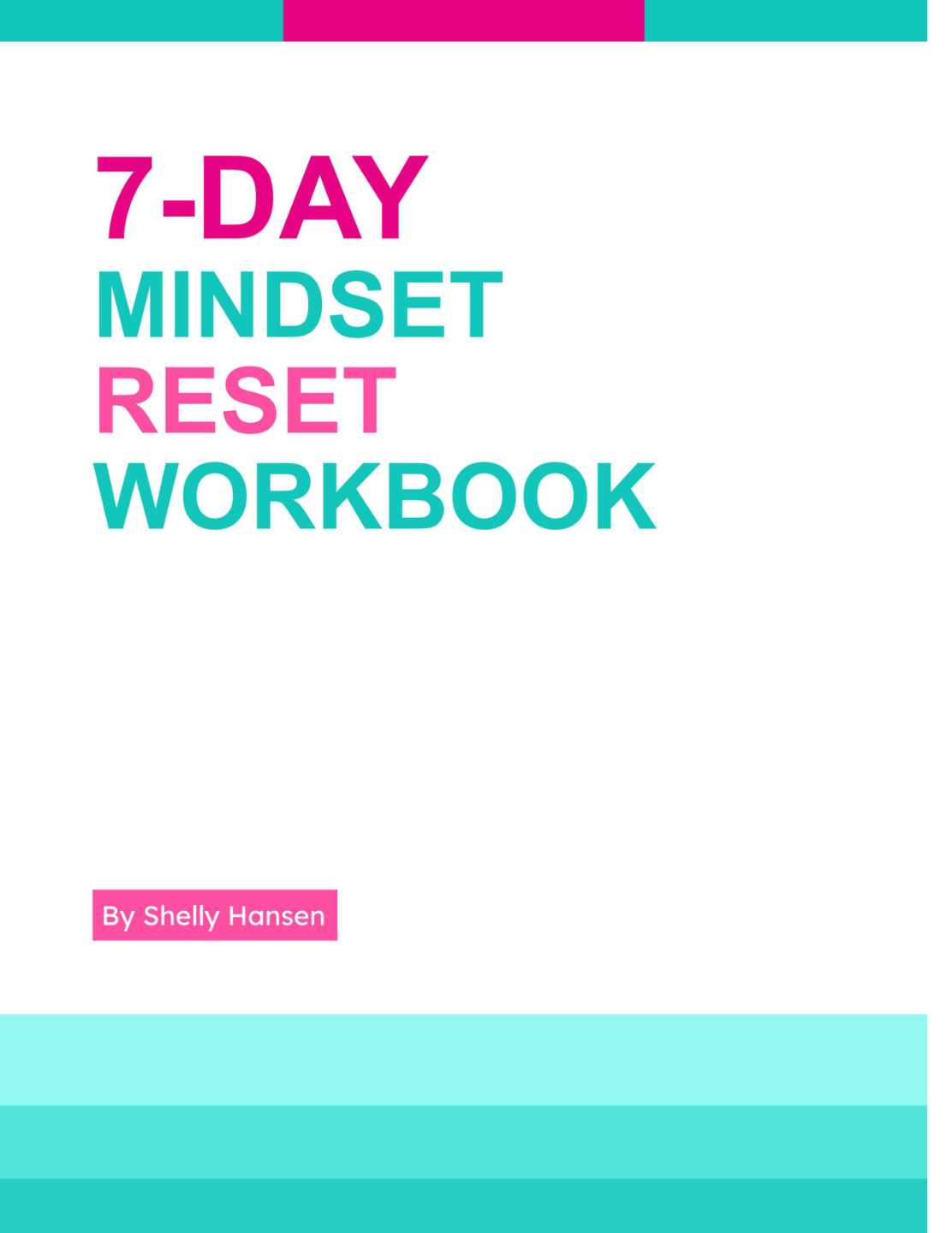
If this resonated with you, I created a free 7-Day Mindset Reset workbook designed to interrupt those baseline patterns and help you retrain your system gradually. You don't need more motivation. You need capacity. And that is something you absolutely can build.
Grab your free copy here →7-Day Mindset Reset
Explore My Blogs